
19 Mar Restructuring global value chains in an evolving global landscape
The global value chains (GVCs) remain central to the world economy despite overlapping
crises such as the COVID-19 pandemic, geopolitical frictions, and climate challenges.
According to the Global Value Chain Development Report 2025, GVCs still account for
about 46 % of world trade, slightly below their 2022 peak, showing resilience and
adaptation rather than unravelling.
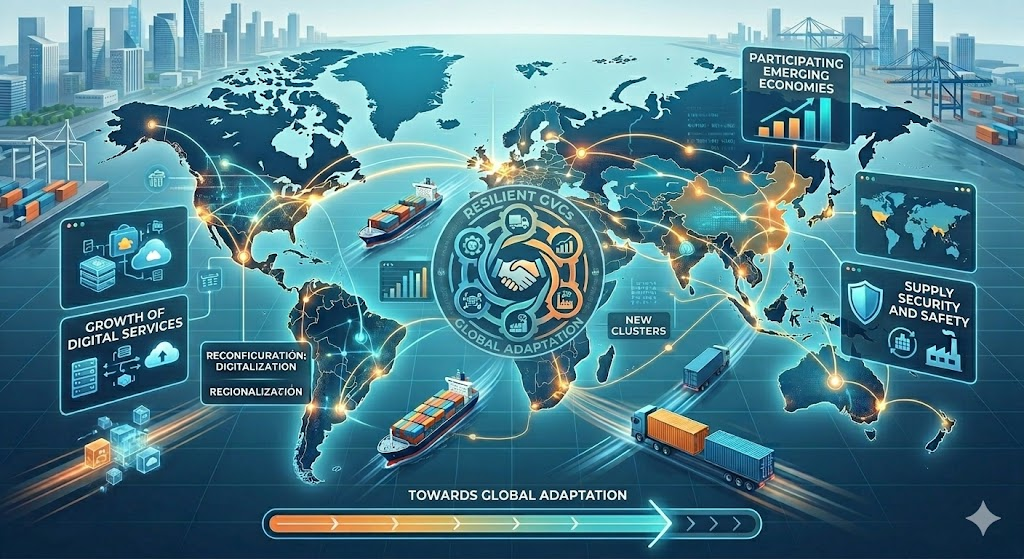
Stolzenburg (2026) analyses how, rather than a process of deglobalization, global value
chains are undergoing a reconfiguration driven by digitalization, regionalization, and
security-related concerns. For example, services value chains have grown due to digital
technologies, and emerging economies are increasing their participation in global
production networks.
The article also discusses the rise of industrial and environmental policies, as well as
targeted trade agreements (“mini deals”) in areas like digital trade and critical minerals,
which can promote cooperation but need greater transparency and coordination to avoid
negative spillovers. The overall message highlights the adaptability of GVCs, while
acknowledging potential future tensions and uncertainties.
Source:
25 February 2026 – Stolzenburg, V. https://www.wto.org/spanish/news_s/news_s.htm